

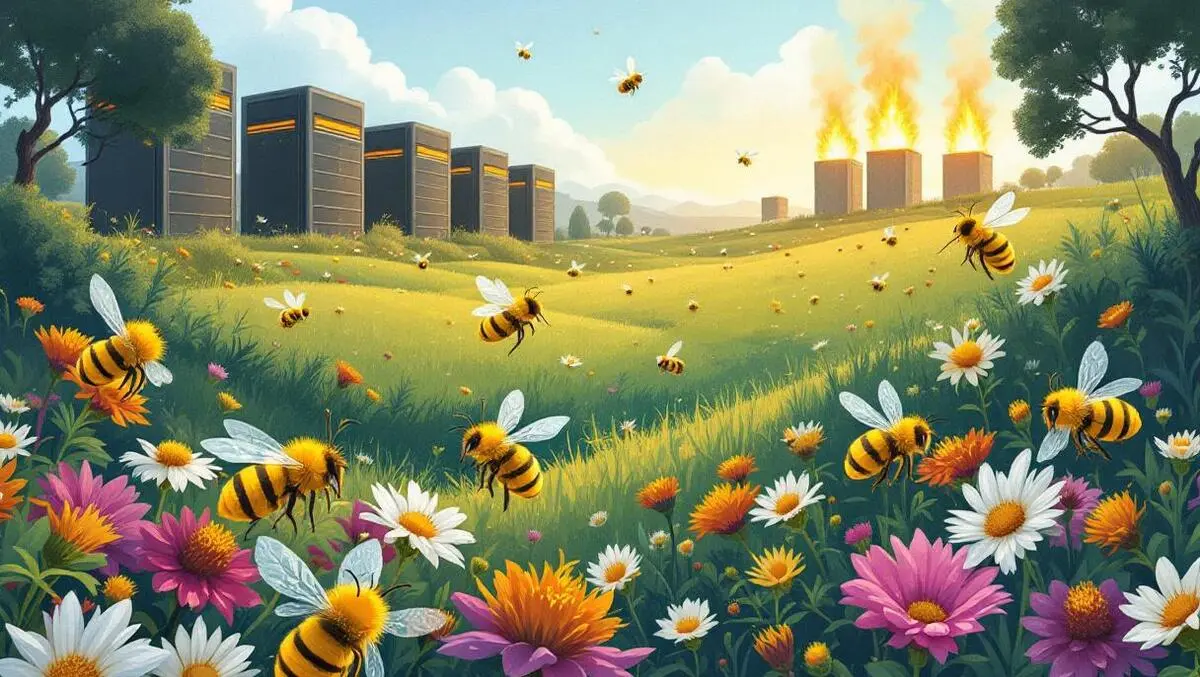
AI infrastructure growth threatens 14 million Australian bees a year
Tue, 11th Nov 2025
A new study by the University of Sydney has found that expanding artificial intelligence infrastructure could significantly threaten Australian bee populations, with up to 14 million bees projected to be lost annually due to increased emissions and shifting climatic conditions.
Bee losses
Researchers estimate that carbon dioxide emissions driven by AI-powered data centres and associated technology infrastructure could contribute to a 3% to 12% increase in the annual failure rate of bees in Australia. This would translate to the loss of between 3.5 million and 14.1 million bees every year, heightening risks for agriculture and biodiversity.
The study introduces a "bee barometer" framework, demonstrating that even minor increases in global temperatures-attributable in part to digital infrastructure-can have significant knock-on effects on pollinator populations. These changes, triggered by phenomena such as heat stress, more frequent bushfires, and the spread of harmful pests like Varroa mites, threaten both managed honeybees and native Australian bee species.
Economic risks
Australia's bee-dependent agricultural sector, valued at AUD $4.6 billion per year, could face considerable disruption if pollinator decline continues. The report warns that climate change impacts, intensified by digital growth, put food security and ecosystem services at risk.
Digital footprint
Global cumulative CO2 emissions from AI infrastructure are projected to reach between 4.8 and 15.4 gigatonnes over the period 2024 to 2035. These emissions could raise global average temperatures by between 0.0026°C and 0.0084°C. The environmental costs result not only from energy-hungry model training and deployment but also from distributed computing, edge devices, and the embedded energy required to manufacture and run AI equipment.
"AI is reshaping how we work, live and govern, but its growth comes with an energy and environmental footprint that must be acknowledged," said Dr Rob Nicholls, Centre for AI, Trust and Governance, University of Sydney.
Dr Nicholls said, "We need a new model of AI innovation, one that is carbon-aware, ecologically informed, and responsible." He also noted, "The future of AI and ecological health do not have to be in conflict."
Recommendations outlined
The report calls for more robust oversight and environmental management of AI infrastructure. Recommendations include conditional access to the electricity grid for new hyperscale data centres above 100 MW, adoption of carbon-aware computing standards, and cooperation between technology and conservation sectors to ensure that emissions growth does not come at the expense of pollinator and ecosystem health.
IBM contributed to the report, highlighting the potential for AI to play a dual role in climate management. Ravi Kumar Mandalika, IBM Australia's Executive Partner and Energy, Sustainability & Utilities Industry Lead APAC, said, "AI can be a powerful tool in the sustainability space, if we build it that way.
"We're seeing growing interest in AI systems that can help to improve efficiency, assess risk, and enable smarter energy use. These tools, when designed responsibly, can help future-proof both business and the planet," said Mandalika.
Critical years ahead
The study identifies 2024 to 2030 as a pivotal period for balancing digital growth with ecological preservation. Researchers suggest that Australia is strongly situated to develop policies and business practices that support both digital transformation and environmental health.
Dr Nicholls said, "This report provides a roadmap for building a digital future that serves people and the planet."