


Hitachi Energy has warned that Australia's data centre expansion is adding to supply chain pressure for major electrical equipment, and says stronger co-ordination is needed to avoid delays to new projects.
The warning focuses on the high-voltage equipment needed to connect and run large data centres, as demand from the sector rises alongside heavy investment in transmission networks, renewable energy and broader electrification.
Bernard Norton, Managing Director of Hitachi Energy Australia, said demand from new AI-focused facilities was placing exceptional pressure on electricity networks in growth corridors around Sydney and Melbourne. For developers, the issue extends beyond access to electricity supply to the availability of the equipment needed to deliver that power.
"The challenge for data centre developments is not just energy; it's also the supply of the high voltage equipment needed to power the sector," Norton said.
He said the market for data centre equipment in Australia had expanded sharply in recent years and was still growing.
"The market size for data centre equipment in Australia has tripled over the past three years and it's expected to reach US$9 billion by 2031.
"This growth is coinciding with extra demand from the energy transition and the electrification of transport and industry.
"It's creating the perfect storm for supply chains. If we want to avoid long delays to data centre development and critical electricity projects, we need to change the way we do things."
Rising demand
The backdrop is a fast-growing data centre market that is becoming a larger part of Australia's power system. Oxford Economics projects that data centre electricity consumption in Australia will increase tenfold over the next 25 years to 35 TWh by 2050, accounting for 10 per cent of the country's total energy consumption.
The Australian Energy Market Operator has also flagged a near-term jump. Under its accelerated transition scenario, data centre electricity use is expected to triple to just over 13 TWh by 2030.
Grid connection data gives a sense of the scale now in development. At the end of June, AEMO said 17 proposed data centre projects with a combined maximum connection capacity of 9 GW were moving through stages of the transmission connection process. Of those, 12 projects representing 7.6 GW were at the application stage, while five projects representing 1.4 GW were in implementation.
That figure is significant in the context of the wider electricity market. Maximum demand on the National Electricity Market reached 36 GW during the 2025-26 summer season, putting the pipeline of proposed data centre loads into broader system context.
Industry tracker DC Byte suggests the market is also shifting towards much larger facilities. More than half of the data centre applications it tracks in Australia have a capacity of 100 MW or more, indicating that the next wave of development differs markedly from much of the existing installed base.
Large hubs remain concentrated in Sydney and Melbourne, but the development map is widening. Adelaide, Brisbane, Canberra and Perth all have existing facilities and more projects in planning, while regional areas including northern Tasmania and the Pilbara are emerging as possible locations for larger sites.
Equipment pressure
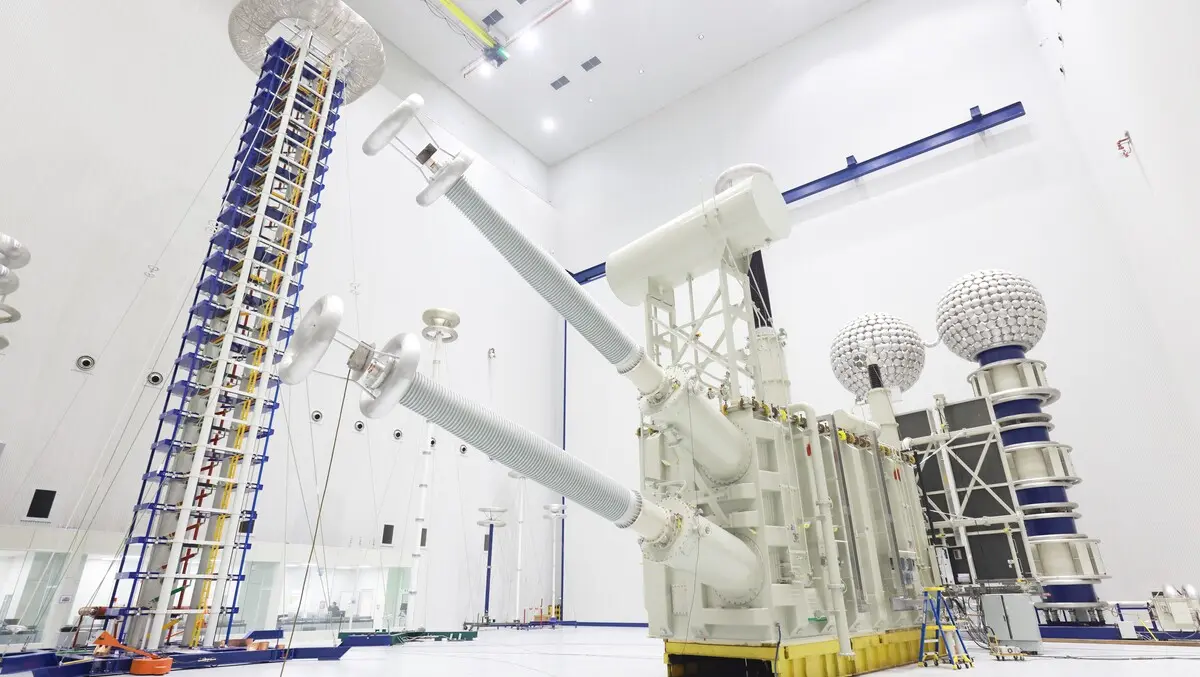
Hitachi Energy said the newest AI-oriented facilities are about five times larger than existing data centres and can require dedicated transmission substations. Each may need about four large power transformers weighing more than 200 tonnes each. A substation of that scale can supply roughly 100,000 homes.
Those requirements are feeding into a global manufacturing bottleneck for transformers and other heavy electrical equipment. Hitachi Energy, which supplies transformers and related equipment to Australian projects including Marinus Link and HumeLink, estimates that 1,400 high-voltage transformers will be needed worldwide by 2030 to serve new data centres.
Norton said delivery times for transformers had lengthened as manufacturers dealt with competing orders from grid expansion and decarbonisation projects across multiple markets.
"High voltage transformers take time to construct. Lead times for this equipment have increased significantly due to the global energy transition - it's basically doubled," Norton said.
He said Hitachi Energy had expanded its own production footprint, but much of the additional output was already committed.
"As part of a multi-billion-dollar expansion program, Hitachi Energy has invested US$1.5 billion to expand electricity transformer manufacturing and production, but much of that extra capacity is already committed.
"The supply-side crunch is felt equally across other equipment classes. The risk is that AI growth is increasingly constrained not by computing technology, but by power infrastructure.
"We need earlier co-ordination, better forward planning and smarter procurement between developers, the energy sector and technology providers to prevent bottlenecks.
"Conversations focused on a 'program of works' rather than individual projects, manufacturing slot availability, and long-term partnerships are becoming the norm."
A separate research paper by Global Transmission Report reached a similar conclusion, finding that some individual data centre projects were larger than any existing load on electricity networks. Simultaneous demand from renewable energy deployment, grid expansion and modernisation, and data centre construction was increasing pressure on the supply of electrical equipment.
Norton said greater certainty on project pipelines would help both developers and manufacturers plan investment.
"This helps drive certainty for projects and certainty for manufacturers, increasing bankability for projects and bankability for manufacturing capacity expansion," Norton said.