

Red Hat names ANZ winners for APAC innovation awards
Tue, 1st Sep 2026
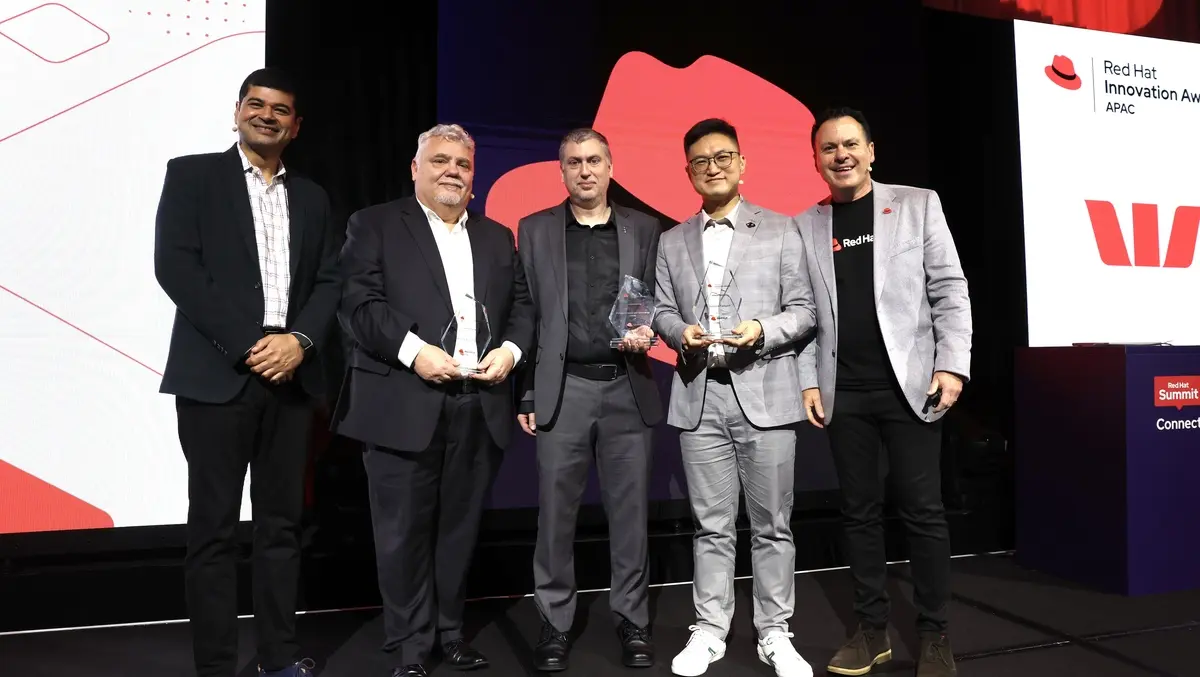
Red Hat has named Auckland Transport, Defence Science and Technology Group, and Westpac New Zealand as the Australia and New Zealand winners of its APAC Innovation Awards 2026. The awards recognise projects built on open source technology.
The three organisations were recognised across cloud-native development, hybrid cloud infrastructure, automation, and virtualisation, highlighting different approaches to modernising operational systems in transport, defence research, and banking.
Auckland Transport was recognised for Theia, an in-house computer vision platform developed to monitor CCTV feeds across the city's transport network. The agency used Red Hat OpenShift Platform Plus as it moved away from legacy third-party systems and manual monitoring of thousands of video streams.
The project is intended to give transport operators real-time traffic monitoring and incident detection. The system now also extends beyond roads into rail, ferry, and parking operations, broadening its role across the network.
Previously, CCTV monitoring was largely manual and reactive, limiting the real-time intelligence available to traffic teams. The move to a cloud-native system was designed to improve scalability across multiple sites while generating data for transport operations and planning.
Dr Derek Zhang, Delivery Manager, Computer Vision, Auckland Transport, said the project was part of a longer-term effort to adapt to the city's needs.
"Working with Red Hat has given us the flexibility to grow our Computer Vision capabilities as Auckland's transport needs evolve. By building on open technologies, we can continue exploring new ways to make journeys safer, more efficient and more reliable for Aucklanders," Zhang said.
Defence Science and Technology Group, part of Australia's Department of Defence, won for a secure research environment created for a strategic code collaboration exercise involving Five Eyes member nations. Its Cyber Integration team needed a platform where researchers could work on both traditional and newer workloads under defence accreditation.
Using Red Hat OpenShift, the group cut the time needed to build the environment from 14 weeks to two, according to Red Hat. It also doubled the number of research sprints completed in each hackathon cycle, from six to 12.
The environment supports virtual machines and containers and is also intended to support future artificial intelligence work. It has since been used as a model for similar collaboration environments within the organisation.
Shane Bennett, Group Leader, Cyber Integration, Defence Science and Technology Group, Department of Defence, said the programme was designed to balance speed and control.
"In defence research, the ability to collaborate and experiment quickly is critical. Working with Red Hat enabled us to create a secure environment that supports both innovation and the stringent requirements of the industry. Red Hat has helped us bring those priorities together, giving our researchers a strong foundation to collaborate, experiment and develop sovereign capabilities," Bennett said.
Westpac New Zealand, which serves more than 1.5 million customers, was recognised for a programme to bring more of its core technology infrastructure under internal management. The bank aimed to reduce operational complexity, lower manual workloads, and address resilience and regulatory concerns.
Under its Core Infrastructure Initiative, Westpac New Zealand standardised on Red Hat Enterprise Linux, Red Hat OpenShift, Red Hat Ansible Automation Platform, and Red Hat Satellite. The move reduced dependence on external vendors and replaced older community-supported infrastructure that had created scaling constraints, according to the bank.
The bank also introduced automation for processes including patching and provisioning, while decommissioning obsolete nodes to improve security. The programme freed engineering time previously spent on maintenance and routine infrastructure tasks, according to Red Hat.
Garry Daniels, Head of Infrastructure Services and Digital Workplace, Westpac New Zealand, said the shift had changed how teams use their time.
"Taking greater ownership of our technology has given us the opportunity to simplify how we operate and create a scalable foundation for innovation. With Red Hat's solutions, we have reduced manual effort and established a resilient, automated platform that enables us to accelerate the delivery of new capabilities at scale. As a result, our engineering teams can focus more of their time on driving meaningful improvements and delivering better outcomes for our customers," Daniels said.
Regional backdrop
Across the broader programme, Red Hat recognised 32 winners in 13 countries across Asia Pacific. The award categories cover digital transformation, hybrid cloud infrastructure, cloud-native development, automation, virtualisation, and artificial intelligence.
Daniel Aw, Vice President and General Manager, APAC, Red Hat APAC, said the awards reflected a shift in how organisations are approaching technology change.
"Enterprise technology is becoming more complex than ever, but success is no longer about how many new technologies an organisation adopts. What matters more is how effectively these solutions work together to address real business challenges and deliver tangible value. This year's winners demonstrate that the organisations best positioned for long-term success are those building open, flexible foundations that allow them to innovate on their own terms. Their achievements are a testament to what organisations can accomplish when technology decisions are guided by business needs rather than trends, and it is this approach that we are proud to celebrate through the Red Hat APAC Innovation Awards," Aw said.