

Rockwell embeds automation in PBS Biotech's MiniPRO
Wed, 30th Sep 2026 (Today)
Rockwell Automation has embedded its automation technology into PBS Biotech's MiniPRO bioreactor platform for cell therapy process development and later manufacturing scale-up.
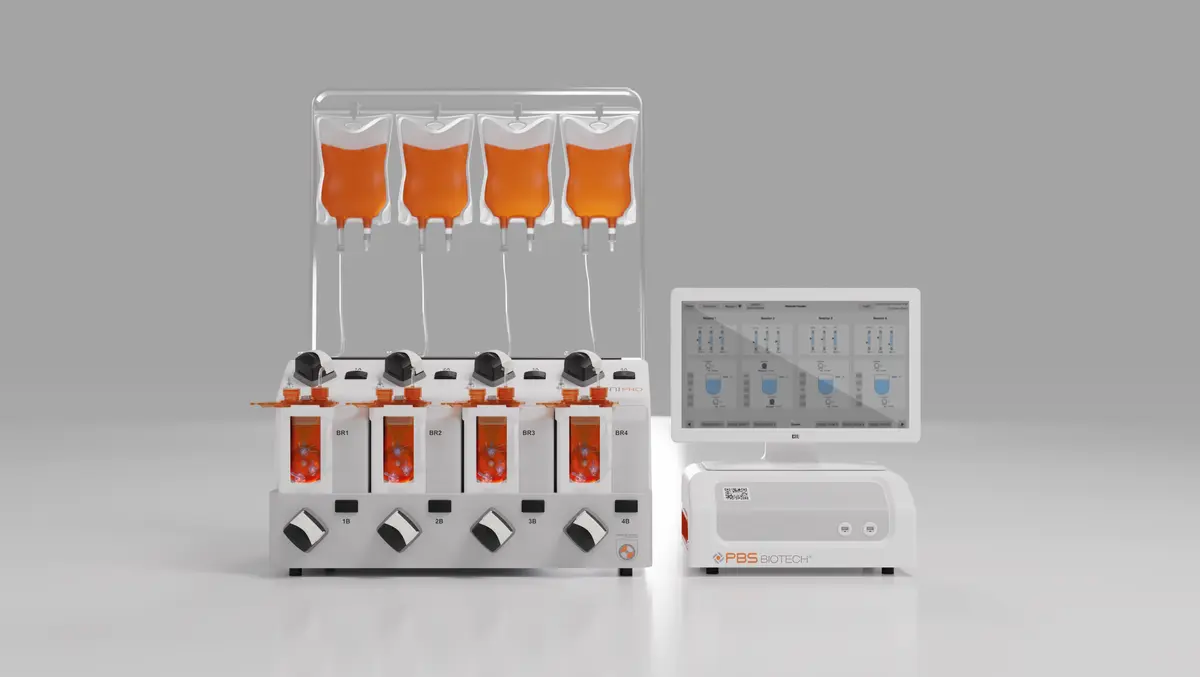
PBS Biotech makes single-use bioreactor systems. Its MiniPRO platform is a closed, automated system with up to 24 independently controlled bioreactors for parallel process development. The setup uses Rockwell's FactoryTalk software and Process Library to provide real-time process control and visibility, while also fitting into the broader PlantPAx distributed control system used in larger cell therapy facilities.
The arrangement addresses a recurring issue in advanced therapy manufacturing: developers often rely on low-throughput workflows, manual steps, and non-standardised systems during early development. Those conditions can make it harder to reproduce results and transfer processes into regulated production environments.
The goal is to give users a development system that more closely resembles commercial manufacturing conditions, helping teams carry process knowledge and operating history into later stages of production.
"Rockwell technologies let us provide industrial-grade control of critical process parameters, so users are generating high-quality process data in an environment that looks and feels like commercial manufacturing," said Sharon Harvey, Director of Product Management and Strategy, PBS Biotech.
"That's really advantageous because developers are able to introduce this during the product development stage and then evolve towards clinical and commercial manufacturing with history and control," Harvey said.
An early user of the platform was the Advanced Regenerative Manufacturing Institute, a non-profit organisation focused on the US bioeconomy. It used the system as part of an integrated manufacturing line.
"Typically, you don't see this control in a system as small as the MiniPRO," said Tom Bollenbach, Chief Technology Officer, ARMI.
"With our first integrated manufacturing line, our biggest challenge was getting the process control system to sequentially hand off between subsystems. Because the MiniPRO has Rockwell controls, system integration is streamlined. When we talk to the supervisory system that makes hand-offs happen, it's very easy to get them to talk to each other. That enables us to build bigger manufacturing lines," Bollenbach said.
PBS Biotech said performance on the MiniPRO has been consistent with its larger Vertical-Wheel bioreactors. That continuity could help developers produce data that remains relevant as programmes move from development into Good Manufacturing Practise settings.
Standard systems
One of the central issues in cell therapy production is the gap between research systems and commercial manufacturing equipment. Many early-stage platforms are built around proprietary or PC-based tools that are difficult to integrate with plant-wide control systems, creating extra work as developers move toward clinical or commercial output.
By using a more widely adopted automation environment at the development stage, PBS Biotech and Rockwell aim to reduce that transition risk. The approach also reflects a broader push in life sciences manufacturing to standardise software and controls across development and production.
For Rockwell, the project extends its presence in the life sciences sector, where automation suppliers are trying to position themselves earlier in the product lifecycle rather than only at the factory build-out stage. Embedding controls in smaller development systems gives equipment users a route into manufacturing architectures already familiar to larger industrial operators.
"As cell therapy programs advance, seamless tech transfers between development outputs and manufacturing requirements help reduce risk during scale-up," said Matt Weaver, Vice President, Global Industry - Life Sciences, Rockwell Automation.
"By introducing a widely used automation platform during process development, the MiniPRO helps teams preserve process knowledge and control as they progress toward clinical and commercial manufacturing," Weaver said.