


Australian SME hiring slows as MYOB data shows July fall
Thu, 15th Oct 2026 (Today)%201.webp)
MYOB data showed Australian small business employment fell in July, pointing to a slowdown in hiring across the SME sector.
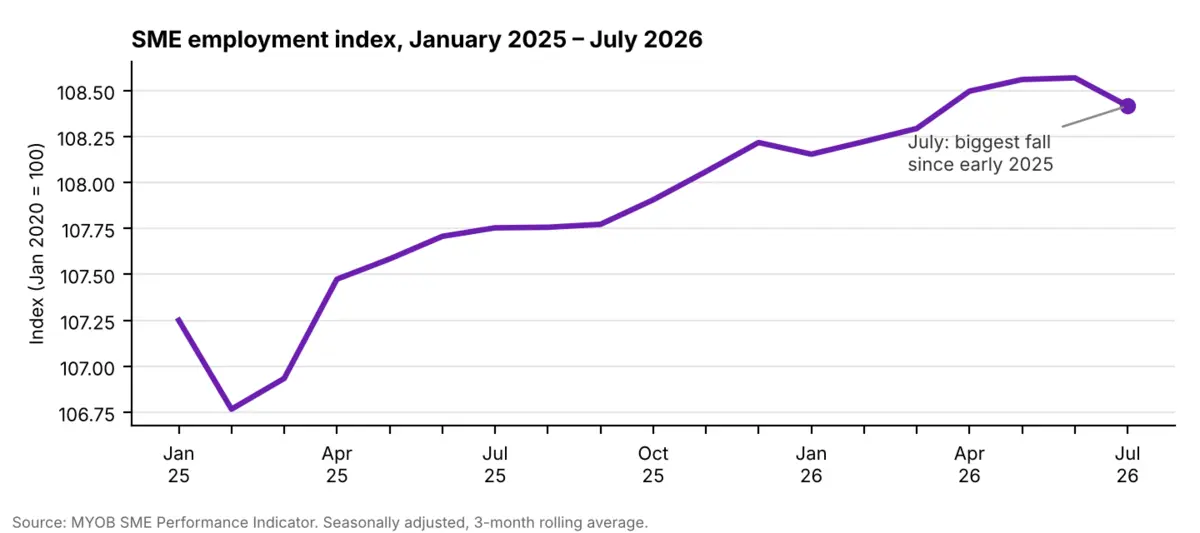
MYOB's SME Performance Indicator, based on anonymised data from more than 200,000 businesses, found employment dipped 0.6% in July, the largest monthly decline since January 2025. On a three-month average basis, employment edged down 0.1%, the first fall since January.
The result breaks a run of steady gains through the first half of the year. In the 12 months to June, SME employment had risen 0.8%, but the July decline reduced annual growth to 0.6%.
Separate measures in the dataset suggested productivity was under pressure before headcount fell. Between April and July, SME employment was broadly flat, rising 0.1%, while output per worker fell 2.4% and inflation-adjusted payroll spend per worker dropped 2.3%.
The figures cover businesses with up to 19 employees and track activity across sectors including transport, hospitality, education, agriculture, health care and construction.
Sector split
Transport, Postal and Warehousing was the strongest-performing sector over the four months to July. Activity rose 10.3% between April and July compared with December to March, while revenue per worker increased 3.4% and costs per worker fell 4.9%. Headcount was unchanged.
Sales in transport rose in April and held at that level through July. The data coincided with the federal government's temporary fuel excise relief, which lowered operating costs for transport operators.
At the other end of the market, Property Services recorded the weakest result. Activity fell 12.4% between April and July compared with the previous four-month period. March had been stronger, supported by end-of-financial-year activity, while June marked the low point before a partial recovery in July.
The softer property reading aligned with broader official data. Australian Bureau of Statistics figures showed output in rental, hiring and real estate fell 0.5% in the June quarter.
Hospitality posted some of the sharpest labour market changes. Employment in Accommodation and Food Services fell 2.3% in July, the sector's steepest monthly decline in two years, and was down 1.3% between April and July compared with December to March.
Even so, output per worker rose 1.7% over that period. Revenue per worker was broadly unchanged at minus 0.3%, while costs per worker fell 2.8%, suggesting operators cut spending to protect margins.
Education and Training also reduced staff, with employment down 0.9%. Output fell 8.1%, while revenue per worker declined 2.4% and costs per worker rose 2.2%.
Agriculture also shed jobs, with employment down 0.5%. Health Care and Social Assistance continued to add staff, with employment up 1.2%, while Construction, the largest SME employer in the dataset, was broadly steady at 0.3% growth.
Economic signal
The data suggests smaller businesses are responding to tighter economic conditions by pulling back on hiring and watching labour costs more closely. The figures come as markets and businesses assess the path of interest rates and the resilience of employment.
Paul Robson, Chief Executive Officer at MYOB, said small firms tend to register shifts in demand and costs early.
"As the Reserve Bank weighs its next move, small businesses are an important part of the story. The data implies that employees are feeling the effects of economic tightening, and after a stronger first half of the year they are being more careful with decisions around employment. Small businesses are a bellwether for the broader economy. They can turn around quickly, but only if costs stabilise and owners have the confidence to back themselves on the next hire," Robson said.
MYOB's dataset is drawn from payroll and business records across enterprises with between one and 19 employees. It uses those records to estimate changes in employment, output and labour costs by industry, with figures adjusted for seasonality and inflation.
On that measure, the latest results suggest SMEs entered the second half of the year with weaker momentum than earlier in 2026, particularly in consumer-facing and property-related sectors, while transport and health remained more resilient.
"A good first step is a conversation with your accountant or bookkeeper about cash flow and hiring plans. Free government resources at business.gov.au can also help owners find support for hiring, digital adoption and managing costs," Robson said.