

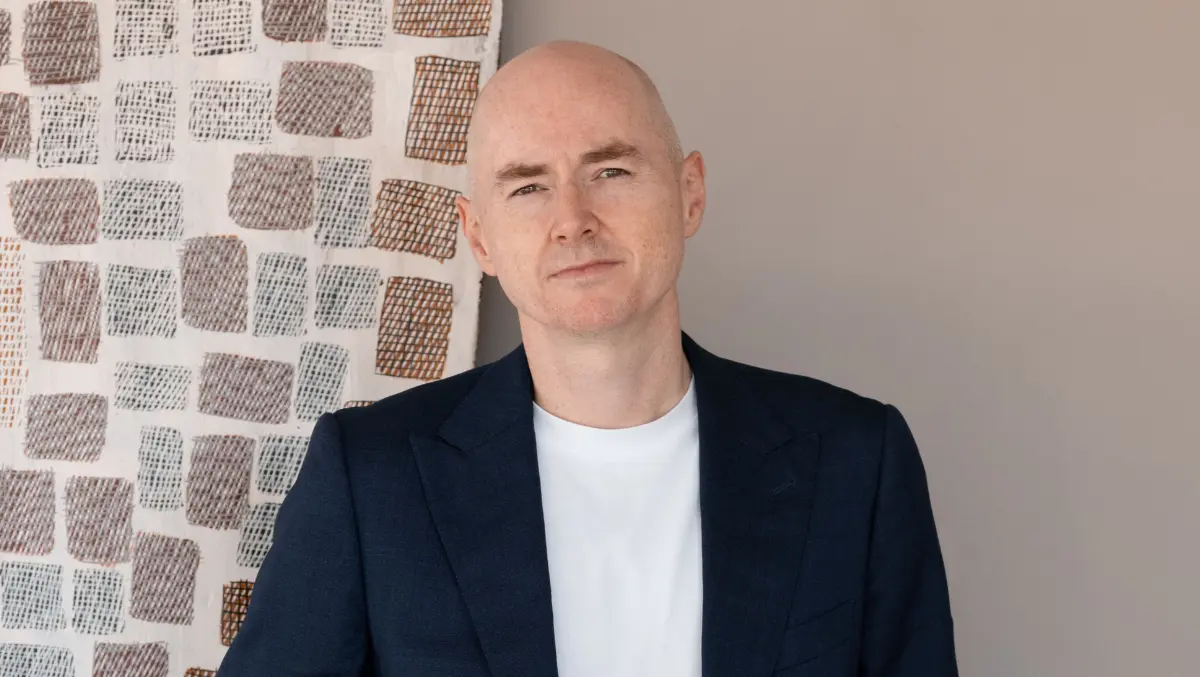
Dom Pym built one of Australia's most beloved banks by refusing to think like a banker
Mon, 3rd Aug 2026
I recently had the pleasure of sitting down with Dom Pym to better understand what he described as "a 30-year overnight success story". It was a good line. One of many he delivered over close to an hour and a half in the studio together. Dom has so many great stories to tell, and he tells them well.
But behind the self-deprecating line was a revealing truth about how we tell founder and success stories. We tend to tell them backwards, with the benefit of hindsight, making every step look like inevitable progress towards the thing we now know they built. But the truth, in real time, tends to be much more messy and non-linear.
In Dom's case, the ingredients that eventually became Up bank included enterprise software, Silicon Valley, an independent record label, some of the earliest apps in Apple's app store, a software company called Ferocia, a pioneering grain exchange, and a live data feed from the Australian Stock Exchange that a 16-year-old Dom built into a market simulation game for his school. Not the obvious CV for a fintech founder, or anyone really, and that's precisely the point.

The record label that built a bank
Before founding Up, Dom spent seven years at SAP working with Fortune 500 companies across global markets. He left to co-found a record label which he describes not a detour, but a formative step. The label became the second iTunes content aggregator in the world when digital disruption was just beginning to reshape the music industry. More importantly, it assembled a group of people including illustrators, designers, animators, creative thinkers who would follow Dom across multiple businesses over the next two decades and eventually form the core team behind Up.
This is one of the most underappreciated patterns in Australian entrepreneurship. The team didn't come together to build Up. They had been building together, accumulating trust and shared experience across different industries, long before they knew what they were ultimately building towards. When the moment arrived, the most valuable assets weren't technology or capital. They were relationships and a collective creative confidence that no single hire could have replicated.
A very un-fintechy decision
When Dom and his team decided to build Up, they made a distinction that sits at the heart of the business's success in that they separated the expertise required to operate in banking from the imagination required to reinvent it.
The conventional approach to launching a new banking business, particularly in one of the world's most heavily regulated industries, is to fill the room with banking people. Dom took the opposite approach. The partnership with Bendigo Bank provided the regulatory infrastructure, institutional trust and community presence required to function as a bank. That freed the Up team to concentrate entirely on where they could create disproportionate advantage, reimagining what the experience of money could actually feel like.
It's a seriously underappreciated form of strategy. Rather than benchmarking against Commonwealth Bank, Westpac or ANZ, Up benchmarked against the apps people actively chose to put on the home screen of their phones like Instagram, TikTok, Snapchat. The question the team was answering wasn't how to build a better bank. It was how to build something people might actually love. The result was that more than 80 per cent of Up's growth came through word of mouth. The external brand was based on its internal culture, the passion for design and experience flowing from the inside out.
Digitising money without making it disappear
One of the more fascinating threads in our conversation was Dom's thinking about what gets lost when money becomes invisible.
A generation that has never handled physical cash has a fundamentally different relationship with spending. The friction, the tangibility, the felt sense of handing something over, is gone. Up's response wasn't to make transactions more seamless. It was to ask whether technology could restore some of what digital had erased, including haptic feedback that made it feel, when you held your phone with Up open, as though coins were moving around inside it.
It's a small detail. But it tells you everything about the business they were trying to build.
What comes next
Since the sale of Ferocia and Up, Dom has reinvested his capital back into the Australian startup ecosystem through his family office, Euphemia. He's invested across 23 funds covering 32 vintages and has a stated ambition to help grow Australia's venture capital sector from its current $17 billion to $1.7 trillion, the scale he believes is required to compete globally. His newest vehicle, the Triple Bubble Fund, is a dedicated fintech fund structured to enable secondary, primary and public market investing in a way that remains largely absent from the Australian market.
His obsession, it turns out, has always been the same creating platforms for other people to build things that didn't exist before. Up was one expression of that. What he's doing now is another. He is the 30-year overnight success story that I suspect has many more decades to run. Because that's the thing that I take away from my conversation with Dom. He's not just a fintech guy, or even a tech guy.
He's a builder. A builder of teams, a builder of experiences, a builder of potential and a builder of community. And every time he builds something he accumulates the knowledge, insights, partners, and ambition to build something even bigger and more impactful in the future. It will be fascinating to see where that takes him and his fellow travellers next.
_
This is an edited extract from StoryWork, a new podcast on business, entrepreneurship and the power of story with Matt Jones. Listen to the full episode at https://storywork.com.au