



Intuit Mailchimp has released data showing first-time buyers accounted for nearly 69% of email orders and more than 73% of SMS orders in Australia during last year's Black Friday Cyber Monday weekend, highlighting the period as a major customer acquisition window for retailers.
The findings come from a Mailchimp and Datalily analysis of more than 44 billion emails and 83 million text messages sent globally from Halloween to the end of the year. In Australia, Mailchimp customers added 18.8 million new email contacts and 1.2 million SMS contacts during that period.
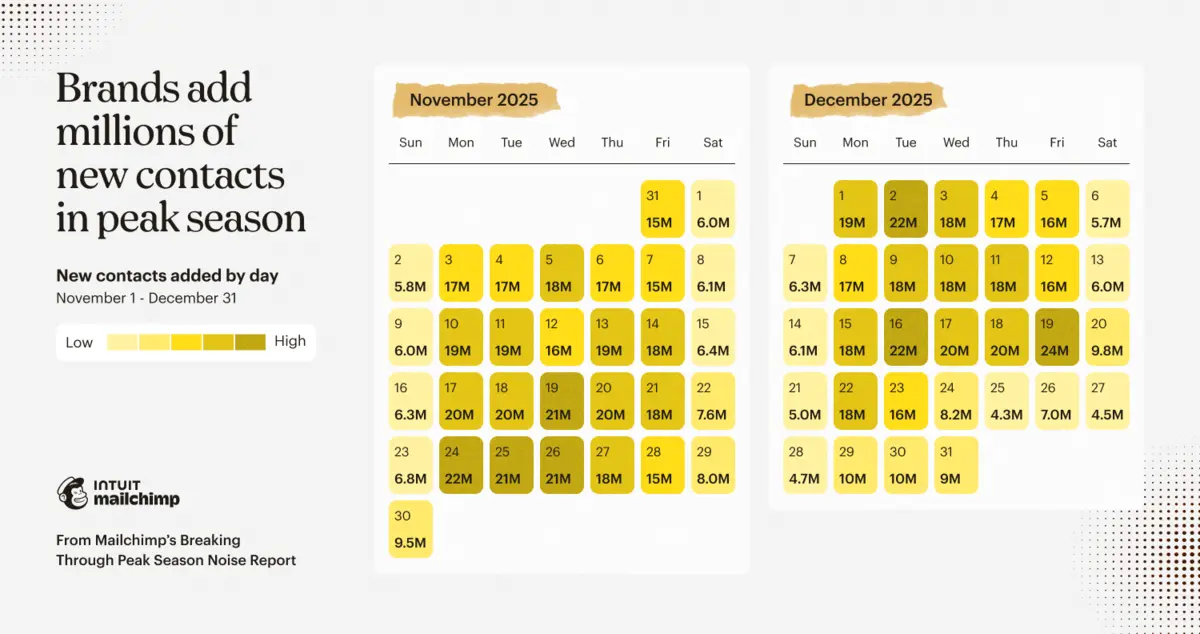
The data points to a crowded market, with retailers using email and SMS for different parts of their marketing strategy. While email generated more revenue overall, SMS delivered stronger results in high-intent moments. Globally, SMS produced up to six times higher order rates than email and three times higher revenue per message. Among businesses using both channels during the Black Friday Cyber Monday period, SMS contributed nearly 20% of combined eCommerce revenue.
Australian results also showed that more tailored messaging had a measurable effect on spending. During the Black Friday Cyber Monday weekend, marketing emails using dynamic content recorded a 3% higher average order value than emails without personalisation.
Mailchimp also reported stronger performance for messages created with generative AI tools. In Australia, emails using generative AI during the peak season achieved a 19% higher order rate and a 21% higher conversion rate than those sent without it.
Jack Tam, Senior Vice President of Product and Engineering at Mailchimp, said the research showed how businesses can use their own data to make better decisions during the busiest trading period.
"Peak season is an opportunity to deepen customer connections. The businesses that thrive use their own customer data to understand when people are ready to act, which messages matter, and where to focus next. This research helps marketers make those decisions with confidence and build customer relationships that endure long after the season ends," Tam said.
Targeting strategy
The broader dataset suggests timing and targeting remain central to campaign performance. Weekend order rates were twice as high as weekday rates globally, even though brands sent about 60% fewer messages on weekends. Around the Black Friday Cyber Monday period, so-called shoulder days also generated stronger engagement. The Sunday between Black Friday and Cyber Monday recorded 59% fewer emails and 82% fewer text messages than Black Friday.
The pattern suggests some retailers may be underusing periods when consumers remain active but competition in inboxes and messaging channels eases. It also adds to evidence that message volume alone does not determine return.
For Australian businesses, the concentration of first-time purchases during Black Friday Cyber Monday raises questions about what happens after the initial sale. Some of those shoppers returned after the holiday period. Globally, 16.6% of customers who made their first purchase during peak season bought again in the first quarter of the following year. The median time to a second purchase was 26 days.
Those figures suggest retailers have a relatively short window to convert seasonal buyers into repeat customers. Mailchimp argued that retention planning before demand peaks may be as important as the promotions used to win first orders during the sales period.
Case study
Mailchimp cited Australian travel business TravelOnline as an example of a shift away from mass email activity towards more segmented campaigns. After reducing broad, high-frequency messaging and grouping customers by engagement, the business recorded a 66% rise in open rates, 38% fewer unsubscribes and a 13% improvement in email return on investment within two months.
Sheri Adamson, Marketing Manager at TravelOnline, described the change as a shift in how the business approached automation.
"The biggest shift for us has been moving away from using automation simply as a way to save time and towards making every customer interaction more relevant. Instead of sending the same message to hundreds of thousands of people, we're sending fewer, more relevant communications based on how customers are interacting with our brand," Adamson said.
The report adds to a broader push by marketing software providers to position AI tools and customer data analysis as practical responses to rising competition for consumer attention. In this case, the Australian figures suggest retailers entering Black Friday Cyber Monday are not only chasing immediate sales, but also trying to capture new customers at a scale that could shape trading beyond the holiday period.
First-time buyers represented 68.6% of email orders and 73.4% of SMS orders during the Black Friday Cyber Monday weekend in Australia.