

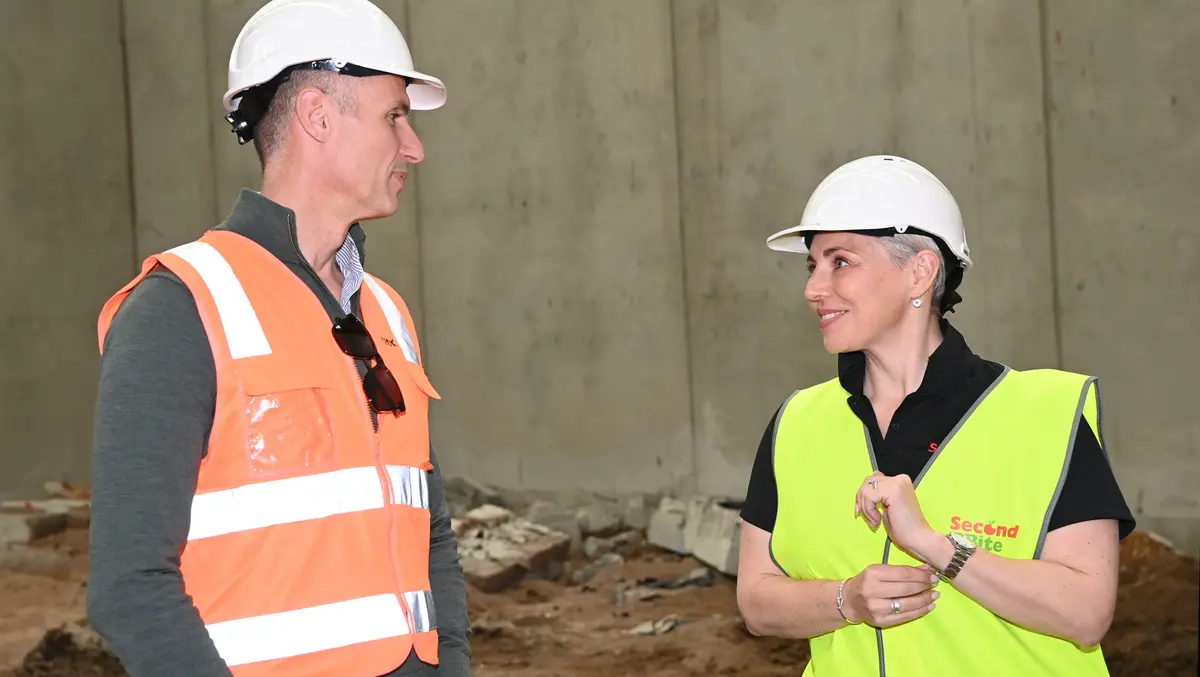
SecondBite builds Victoria cold store as demand rises
Tue, 17th Nov 2026 (Today)
SecondBite has begun construction of a 1,500-square-metre cold storage facility at Derrimut in Victoria, with TMX Transform supporting the project on a pro bono basis.
The expansion comes as the food relief charity reports rising demand from partner organisations and larger volumes of surplus food from retailers.
Built alongside SecondBite's existing Derrimut operations, the new cool room and freezer facility is designed to help the charity receive, store and process more fresh produce and other donated food. Builder Harris HMC is delivering the site, with construction expected to finish by the end of the first quarter of 2027.
SecondBite rescued 26.8 million kilograms of surplus food in 2026, equivalent to 53 million meals. It also pointed to data showing 3.6 million Australians had experienced food hardship for the first time in the past six months.
The charity said 94% of the organisations it supports had seen demand increase from a year earlier, with the rise increasingly driven by working families and dual-income households seeking assistance.
At the same time, retailers are directing more unsold and imperfect food stock to relief channels rather than disposal. That shift has increased the volume of food available for redistribution, but it has also added pressure on storage and handling capacity.
TMX Transform is providing construction project management for the facility. The design had to account for the unpredictability of donated food volumes and product mix, rather than the steadier flow found in a conventional retail or commercial supply chain.
As a result, the Derrimut site has been designed for flexibility and surge capacity. SecondBite has limited visibility over what stock will arrive on any given day, creating a need for storage that can handle sudden changes in volume.
Milan Andjelkovic, Co-Founder and Chief Operating Officer at TMX Transform, said: "An estimated 3.6 million Australians have experienced food hardship for the first time in the last six months, much of it among working families and dual-income households who've never needed this kind of support before. Given that, we wanted to offer SecondBite something more useful than a donation: the project management, construction and network expertise we already have, put directly to work on the ground.
"The supply chain challenge here is unique. Because SecondBite's stock is donated surplus rather than planned procurement, it has little visibility over what volume or product will arrive on any given day. Designing a facility around that kind of variability, rather than a predictable flow of goods, requires a different approach - and it's one we think we can keep supporting as demand continues to grow. At TMX Transform, we're extremely proud to be part of a project that will help get more good food to Australian families who need it."
For SecondBite, the project reflects a broader operational issue facing food relief groups: more food is available for rescue, but charities need infrastructure to keep it safe and move it efficiently. Cold storage is particularly important for perishable items, including fresh produce, which can be lost without adequate handling capacity.
Daniel Moorfield, Chief Executive Officer at SecondBite, said: "The need for food relief is growing, but at the same time there is more good food available that can be rescued and redirected to people who need it. The challenge is having the infrastructure and capacity to handle that food safely and efficiently.
"This new facility will significantly increase our ability to receive and store fresh produce and other surplus food, helping us get more nutritious food out to our charity partners and the communities they support.
"We're incredibly grateful to TMX Transform for bringing its expertise to this project. Its support is helping us build the capacity we need not just for today's demand, but for the years ahead."