

%201.webp)
Lightspark has added AI agent support to its Grid Global Accounts product, allowing account holders to authorise software agents to carry out financial actions within preset limits.
The update expands an existing account product that combines card access, dollar balances, cross-border payouts, bitcoin support and transfers across several blockchains inside partner apps. The new feature lets users delegate selected tasks to AI agents without giving up ownership of their funds.
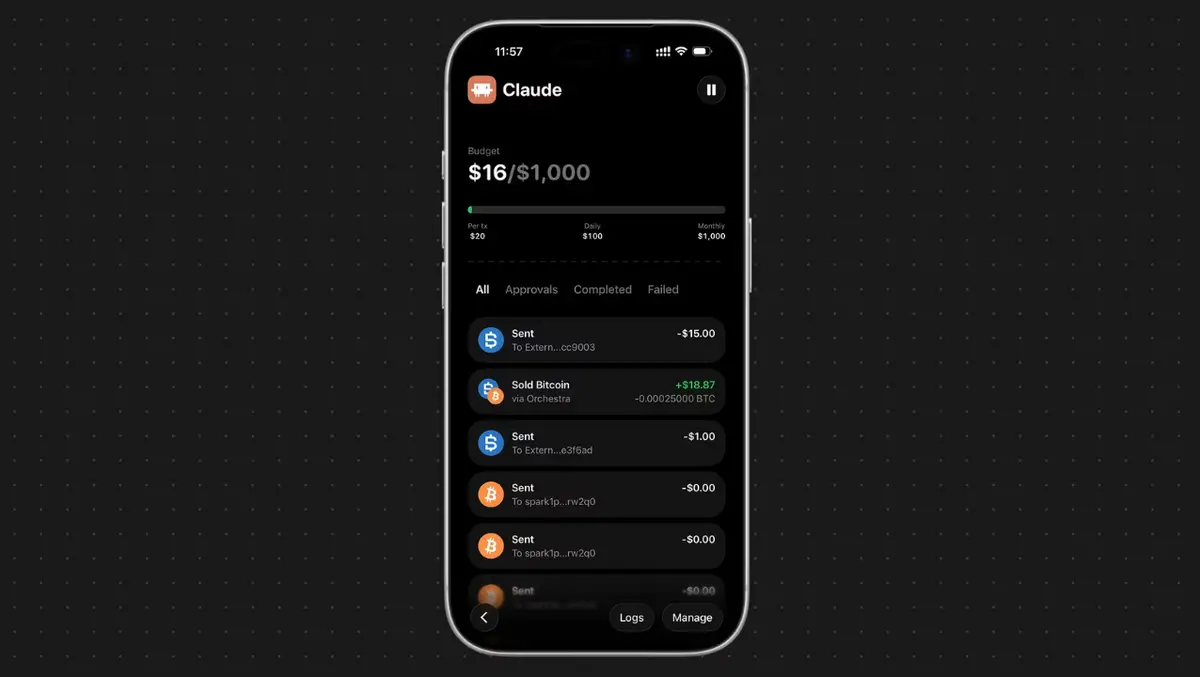
At the centre of the release is a system of policy controls tied to each agent connection. Users can set per-transaction, daily and monthly spending caps, define approval thresholds and limit which payees an agent can use. Transactions below the chosen threshold can proceed automatically, while those above it are held for user approval.
These controls are revocable and auditable, and users can pause or remove an agent at any time. Permissions can also be narrowed to specific actions, such as viewing balances or sending payments, without granting authority to create external accounts or move money for the agent's own use.
Agent controls
The move reflects a broader push across the technology and financial sectors to turn AI systems from advisory tools into software capable of completing tasks on a user's behalf. Many AI products can already search, summarise, code and interact with business software, but payments remain difficult because they require strong authentication, spending controls and clear liability boundaries.
Lightspark is positioning Grid Global Accounts as a way to bridge that gap for firms that want to add financial functions to consumer or developer applications. In practice, partner apps would present users with an account screen, agent management tools, policy settings and transaction history, while Grid handles the underlying authorisation layer.
Lightspark describes the arrangement as a delegated operating model in which the user retains ownership and control of funds. The AI agent receives a scoped credential linked to a user-approved policy rather than unrestricted account access.
Connection options
Lightspark supports several methods for connecting an AI agent, depending on how the software operates. One option uses a command-line installation, in which a user runs a generated command in a terminal and configures the Grid Wallet CLI with a credential restricted by the chosen policy.
A second route uses an MCP endpoint with OAuth support, allowing the agent to start the connection and the user to approve it in the app. A third option is an agent-initiated device flow, intended for autonomous agents without a browser context, in which the agent displays a pairing code, and the user authorises the link separately.
In each case, the permission scope and spending rules are set before any credential is issued. That sequence is designed to ensure users define the boundaries first and the agent acts only within them.
Audit trail
Lightspark also stressed traceability as a core part of the product. Each agent-initiated action is recorded through policy checks, approval status, and final settlement outcome, giving users a record of what the agent did, which account it paid, how much it handled, and how much budget remains.
That audit trail may matter for companies integrating agent-led payments into regulated or sensitive services, where internal controls and user oversight can matter as much as the payment itself. A detailed activity history can also help resolve disputes over whether a transaction was authorised automatically, manually approved or blocked by policy.
Grid Global Accounts already offers a broad set of financial functions through a single integration. According to Lightspark, users of apps built on the product can access a Visa card, a yield-bearing dollar account, payout rails reaching more than 65 countries and more than 14,000 banks, bitcoin support and transfers to Ethereum, Polygon, Base and Solana.
The addition of AI agent support suggests Lightspark sees delegated software activity as a new layer on top of those services rather than a separate product line. Instead of building a standalone AI payment tool, it is making its existing account framework available to automated agents, subject to rules defined by the account holder.
That may appeal to wallet providers, fintech apps and developer platforms that want to let users connect coding agents or autonomous assistants to financial accounts while keeping approval and revocation tools inside their own interfaces. It also gives partners a way to present agent activity alongside balances and spending rather than burying it in account settings.
Lightspark did not announce pricing in the launch material. It presented the new support as part of the same API that partners use to provide global financial accounts, with the added step of surfacing connection flows, policy configuration and activity history to end users.
The company summed up the issue in blunt terms: "AI agents are going to move money. The only question is whether the infrastructure beneath them is built for it: real policy enforcement, real auditability, and real user control. Grid Global Accounts is."